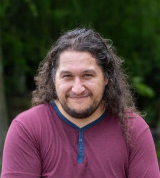
From the flashing lights and clatter of a gaming arcade to the formality of a university lecture theatre, Dr Paul Brown’s journey into academia - like many Māori academics - hasn’t always followed the straightest line.
A statistician and lecturer at the University of Waikato, Paul (Ngāti Hikairo) says that when he first left Linwood College back in 2002 a career in academia, let alone mathematics, was unthinkable. He opted instead for managing a gaming arcade in his home city of Christchurch.
Six years later, Paul decided new beginnings were in order and he enrolled in a science degree at the University of Waikato. One maths paper was the catalyst he needed to put him on a life changing career trajectory.
Paul found his niche developing efficient algorithms for high-quality data analysis. He enjoyed the solitary nature of the work, solving problems with just a whiteboard and his wits. But his reputation as a statistician spread and other researchers came calling with requests to collaborate.
“It took me a while to get used to working with other people and getting my head around all the different fields and specialties, but I’ve come to realise this is how impactful research is done. Through these collaborations with applied data analysis, you can do powerful research and I like this aspect of my mahi,” he says.
The power of data and statistical modelling cannot be underestimated, says Paul. One example of this is a study of Police prosecution rates led by Professor Khylee Quince and Tā Kim Workman. The study involved working with the NZ Police to better understand how demographic factors, behaviours, and spatial and temporal patterns affect prosecution rates. Paul’s modelling found that Māori, on average, were 11% more likely to be prosecuted for the same offences as Pākehā, when all other things were equal. Gang members were also twice as likely as non-gang members to be prosecuted for the same offences when controlling for all other factors in the model (age, ethnicity, prior history) he says.
Such research is why data, statistics and modelling are important. “With this research we showed there was an inherent structural bias within the Police where they are prosecuting some communities far more than others. Now it is up to the Police to do more research to identify what procedures or systems are enabling this bias to occur, so they can work to change them,” says Paul.
In recent years Paul has expanded his expertise to include Indigenous data sovereignty research. One of his current projects involves developing algorithms to understand the global trade of Indigenous data. Paul aims to conceptualise how the cross-border trade of Indigenous data can be valued, including how such data can be identified, labelled, and ultimately valued economically. “There needs to be an awareness of the power of data in Māori communities so people can make informed decisions about what they are giving up when they give their data to big companies, and balance this with the benefits they might receive. Data sovereignty means being able to make these informed decisions,” he says.
Closer to home, Paul is working on a new NPM-funded project on Māori data sovereignty and governance in universities. Paul says while universities have been collecting Māori data for many decades, there is little transparency over what has been collected and where it is stored, in part because of a lack of Māori data governance.
A key problem that Paul is trying to tackle is data discoverability - developing algorithms to locate Māori data inside university data ecosystems. His collaborators Dr Kiri West (Waipapa Taumata Rau) and Dr Maree Sheehan (Te Wānanga o Aotearoa) are focusing on data governance and practical pathways for iwi, hapū and hapori to assert sovereignty over their data.
“Māori communities are being locked out of their own data, and we would like them to be aware of it so they can decide if they want to use it and who has responsibility for it. If they don’t want to do anything, kei te pai, as long as they are aware that it exists, and can make that decision for themselves.”
Data is tremendously valuable, says Paul, and with that comes responsibility. “I try to teach my students that as data analysts, you’ve got to make sure your work has integrity, you’ve got to do things the right way. Anyone that works with data needs to think about their responsibilities to stakeholders, to the people who the data is about, and to their profession to ensure the data is being handled and used appropriately.”