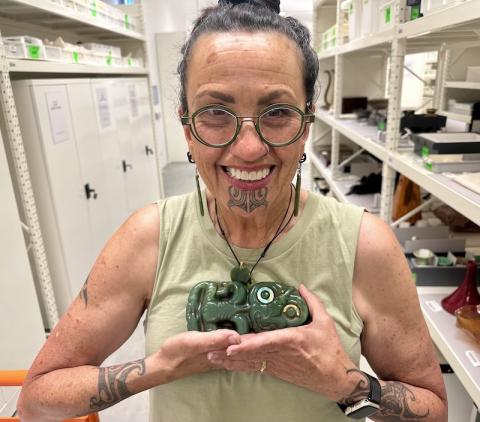
PhD candidate Maarama Kāmira is following in the footsteps of her great grandfather, Ngāpuhi tohunga, historian and genealogist Himiona Tūpākihi Kāmira. And like her renowned tipuna, Maarama’s PhD research is connecting people to their whakapapa and taonga.
While sorting through historical photographs of taonga on her computer, one image left Marama immediately captivated.
“This image of this hei tiki stopped me in my tracks. I realised the hei tiki had a female genitalia, and I knew she was a very, very old piece because once religion had taken hold in Aotearoa, genitalia were removed from hei tiki,”
Intrigued by the image, Maarama immediately made an appointment with the Sydney Powerhouse Museum vault where it was stored.
The meeting was pivotal to Maarama’s research and to unravelling the history of the taonga - named Tangikore - and the whakapapa of those who had worn her.
Maarama says the only clue she had to work with was a sticker on the back of Tangikore, indicating James Albert Norton as her last owner. After following various leads, Maarama tracked Tangikore to Tasmania in the early 1810s when she appeared to be given to Lieutenant Governor Thomas Davey who then passed it to his daughter as a wedding gift. Five successive generations of Davey women subsequently cared for Tangikore, then she came into the possession of a wealthy Sydney socialite and, finally, the vault of the Powerhouse.
But who was Tangikore’s original Māori owner? This is a mystery still yet to be solved, although Maarama is determined to unearth more of Tangikore’s secrets. She suspects Tangikore was either gifted to Thomas Davey by an influential Māori or that the hei tiki was part of a trade deal. “Māori had come to Australia to trade, and they brought their wāhine along with them. One trader who I have identified is a woman called Atahoe, the daughter of influential Ngāpuhi Rangatira, Te Pahi. I suspect Atahoe was the original owner of Tangikore because she was doing deals on behalf of her father in the 1800’s.”
Maarama says the lack of knowledge we have about incredible women such as Atahoe, and other wāhine from the colonial era is indicative of the wider erasure of Maori women from recorded histories of that era.
“Wāhine here in Australia have been written out of history because in colonial times, Pākehā women had no independent standing other than that of their husbands. However, that was not the case in Māori culture.
Maarama says it was normal for Māori men to travel with wives and female relatives, and that these women were also traders. “Te Atahoe was a seminal figure here in Australia. She was more than a daughter and a wife. She was a trader who was an amazing woman - a wahine toa. She came back from India with her convict husband, George Bruce. Although she was brokering deals to trade with some of the big family names in Sydney on behalf of her father, she was written out of history.”
Atahoe’s story continues through her daughter, Mary who was put into an orphanage when her mother died of dysentery. According to Maarama, NSW power brokers, including Samual Marsden, refused to allow young Mary to be returned to her father, or to whānau living back in Aotearoa.
Today, Atahoe and Mary’s uri are living throughout Australia, and Maarama is proud to connect them with their whakapapa. “I got a message from one of Mary’s uri recently who was trying to find the link to Mary and Te Atahoe. After they told me their whakapapa, I confirmed to them they are uri of Te Atahoe and her daughter Mary. They were amazed to find their whakapapa. They have always been told they had a Māori great grandmother, but they didn’t know how to connect with it because of how female stories have been lost.”
“I really value being able to connect people living today with their Māori whakapapa and to the stories of their amazing great, great grandmothers who were so resilient, courageous and who suffered greatly so their uri could survive.”
The story of finding Tangikore is a symbol of what these women went through, says Maarama. “When she was calling out to me from that vault at the Powerhouse, she was crying, ‘I’m here, don't forget me.’ I would like to bring her story and the stories of other incredible Māori women into the light